

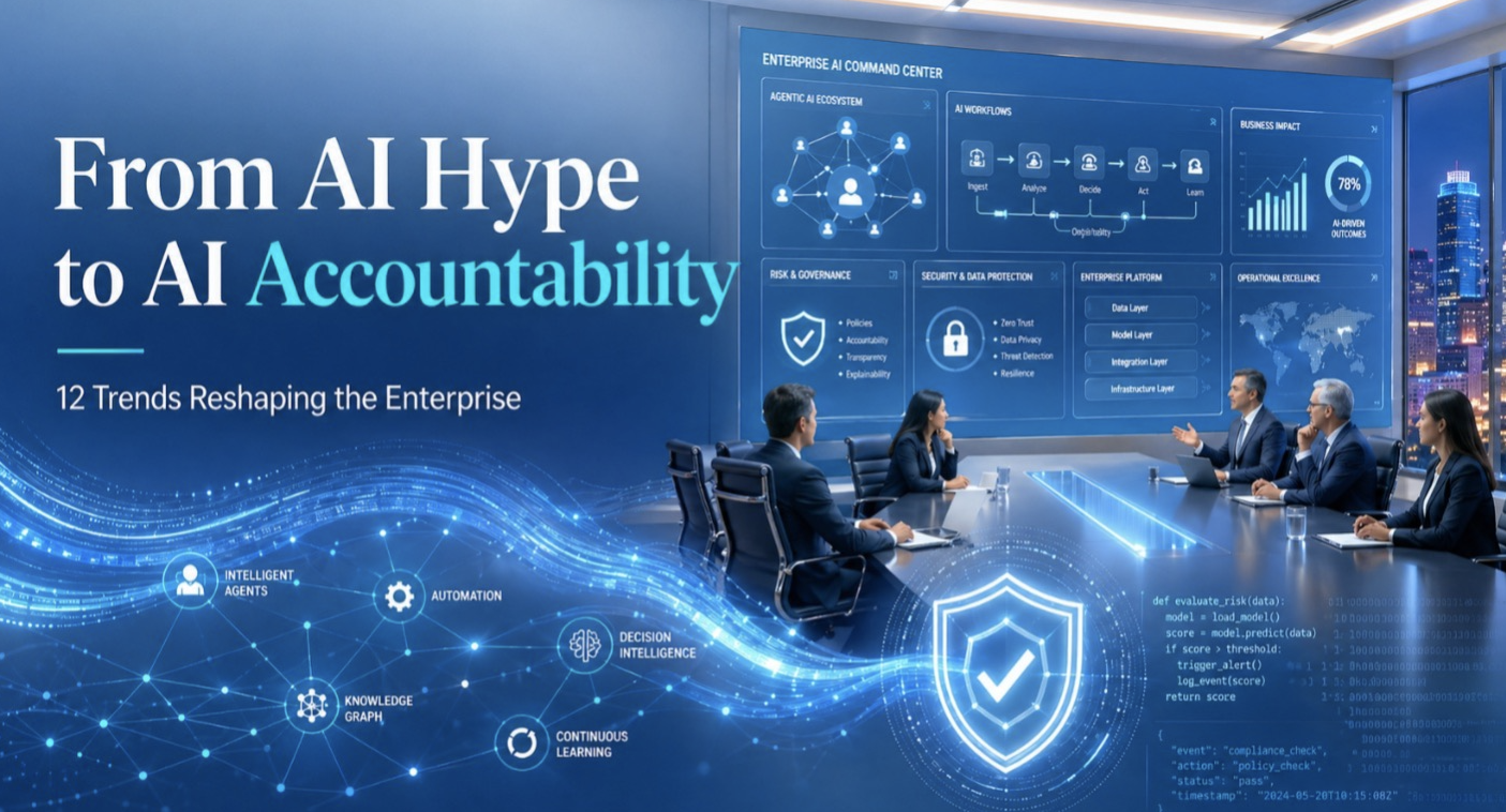
AI is no longer a future strategy. It is already within the enterprise, within the workforce, within software development, within customer operations, and increasingly within board-level risk conversations. The companies that win will not be those that adopt AI the fastest, but those that govern it, secure it, measure it, and turn it into trusted business execution.
For boards of directors, CIOs, CISOs, and other company executives, 2026 is the year AI moves from experimentation to accountability. This is compounded by a lack of clarity in many organizations about corporate AI strategy, let alone the fact that the overwhelming majority lack an AI CoE (Center of Excellence). The executive question is no longer whether AI will transform the business, but whether the business can control, secure, and trust what AI is already transforming.
1. Agentic AI Is Replacing the Chatbot Era
The first wave of generative AI was about asking questions. The next wave is about giving AI a goal and letting it act. Agentic AI can plan, decide, execute tasks, call tools, interact with systems, and work across business processes. McKinsey has called out agentic AI as both a major value opportunity and a new security and trust challenge for technology leaders.
Once AI can act, enterprises need to know what it touched, why it acted, what data it used, and who approved the outcome.
2. Multi-Agent Workflows Are Becoming the New Operating Model
The enterprise will not run on one giant AI assistant. It will run on teams of specialized agents working together across legal, finance, cybersecurity, HR, software development, sales, operations, and customer support. One agent may research, another may analyze, another may execute, and another may validate the output.
This same shift has also accelerated vibe coding and citizen development, where employees can use prompts to create applications, automate workflows, and build software without traditional development cycles. This will create speed and scale, but also complexity and security risks. The next great enterprise challenge will be governing the behavior of digital workers and AI-generated code that can move faster than humans can manually supervise.
3. Shadow AI Is Becoming Shadow Agents
For the last two years, companies have worried about employees pasting sensitive data into public AI tools. That problem has not gone away. It is becoming more serious because employees are now experimenting with AI agents, browser plugins, automation tools, workflow copilots, and unsanctioned AI applications that can access enterprise data.
Shadow AI used to mean unapproved prompts. Shadow agents now mean unapproved actions.
4. AI Governance Is Moving to the Boardroom
Boards are beginning to realize that AI is not just a technology issue. It is a business risk, compliance risk, reputational risk, operational risk, and competitive risk. Directors will increasingly ask management teams the same basic questions: Where are we using AI? What data is going into it? What decisions are being influenced by it? How do we know it is safe, compliant, and aligned with our strategy?
5. AI Data Leakage Is Becoming a Material Enterprise Risk
Data leakage is one of the most urgent AI risks because it can happen quietly. Employees may expose customer data, source code, contracts, intellectual property, financial information, security details, or regulated data without realizing the long-term implications.
NIST's Generative AI Profile was created to help organizations identify generative AI risks and align risk management actions to their goals and priorities. The issue is not simply whether AI tools are useful. The issue is whether the enterprise can prevent sensitive information from leaving controlled environments while still enabling innovation.
6. AI Security Is Becoming Its Own Category
Traditional cybersecurity tools were not designed for AI-native risk. Prompt injection, model manipulation, AI supply chain attacks, unsafe plugins, rogue agents, sensitive prompt exposure, and model abuse require a new control layer.
CISOs will need visibility into AI usage, just as they do into cloud, endpoints, identity, and SaaS. The next major security category will focus on protecting the AI operating layer itself.
7. Smaller, Specialized Models Are Gaining Ground
The market is starting to understand that bigger is not always better. Smaller, domain-specific models can be faster, cheaper, easier to govern, and better aligned with specific business workflows.
A bank, hospital, logistics company, or manufacturer does not always need the largest general-purpose model. It needs the right model, trained or configured around the right data, controlled by the right policies, and measured against the right business outcome.
8. AI ROI Is Replacing AI Theater
The era of 'look, we have AI' is ending quickly. Executives are under pressure to prove where AI improves revenue, reduces cost, increases speed, improves customer experience, strengthens risk management, or creates new products.
AI budgets will still grow, but they will face more scrutiny. The winning companies will connect AI directly to measurable business value, not vague innovation language.
9. Humans Are Becoming Managers of AI Work
The strongest companies are not replacing humans with AI. They are redesigning work so humans can supervise, validate, improve, and direct AI systems. The future workforce will not be human versus AI. It will be humans managing AI, validating AI, and using AI to multiply judgment, creativity, and execution.
That shift may be one of the most important leadership changes of this decade.
10. Sovereign AI and Data Residency Are Becoming Strategic Decisions
AI is now tied to national competitiveness, regulatory requirements, and data control. Governments and enterprises are asking where models are hosted, where data is processed, who owns the infrastructure, and what jurisdiction controls the information.
This is especially important for financial services, healthcare, defense, critical infrastructure, and global enterprises. Sovereign AI is no longer just a policy phrase. It is becoming an architectural decision.
11. Physical AI Is Moving from Lab to Industry
AI is moving beyond screens and into the physical world. Robotics, autonomous warehouses, industrial automation, logistics optimization, manufacturing systems, and AI-enabled field operations are all advancing quickly.
This creates enormous potential for productivity, safety, and operational resilience. It also introduces new risks because AI decisions can now affect physical assets, supply chains, workers, and real-world environments.
12. The Enterprise AI Platform Battle Has Begun
The future will not belong to individual AI tools scattered across the company. It will belong to secure platforms that can orchestrate models, agents, workflows, policies, identities, data controls, approvals, monitoring, and audit trails.
Stanford HAI's 2026 AI Index makes the broader point clearly: AI capabilities are advancing quickly, while the ability to measure and manage those systems is not keeping pace. This is where CIOs, CISOs, and boards need to focus. AI adoption without governance will create speed, but AI adoption with governance will create a durable competitive advantage.
Conclusion: Building Trust Into the Architecture
The companies that win in this AI cycle will not be the ones that simply chase every new model, tool, or agent. They will be the organizations that build trust into the architecture from the beginning. AI is becoming part of how companies think, build, sell, defend, decide, and compete.
That makes governance, security, data protection, and human oversight the foundation of responsible scale. The future of AI belongs to the enterprises that can move fast, stay secure, prove value, and earn trust simultaneously.
Sources
McKinsey & Company. "Why agents are the next frontier of generative AI." McKinsey Digital, 2024.
National Institute of Standards and Technology (NIST). "Artificial Intelligence Risk Management Framework: Generative Artificial Intelligence Profile." NIST AI 600-1, July 2024.
Stanford University Human-Centered Artificial Intelligence (HAI). "Artificial Intelligence Index Report 2025." Stanford HAI, April 2025.